If you're a founder actively building your team right now, you've probably felt it.
The tools are moving fast. Everyone has an opinion about AI and where it should be in your hiring process. And underneath all of it the question keeping you up at night: am I thinking about this right?
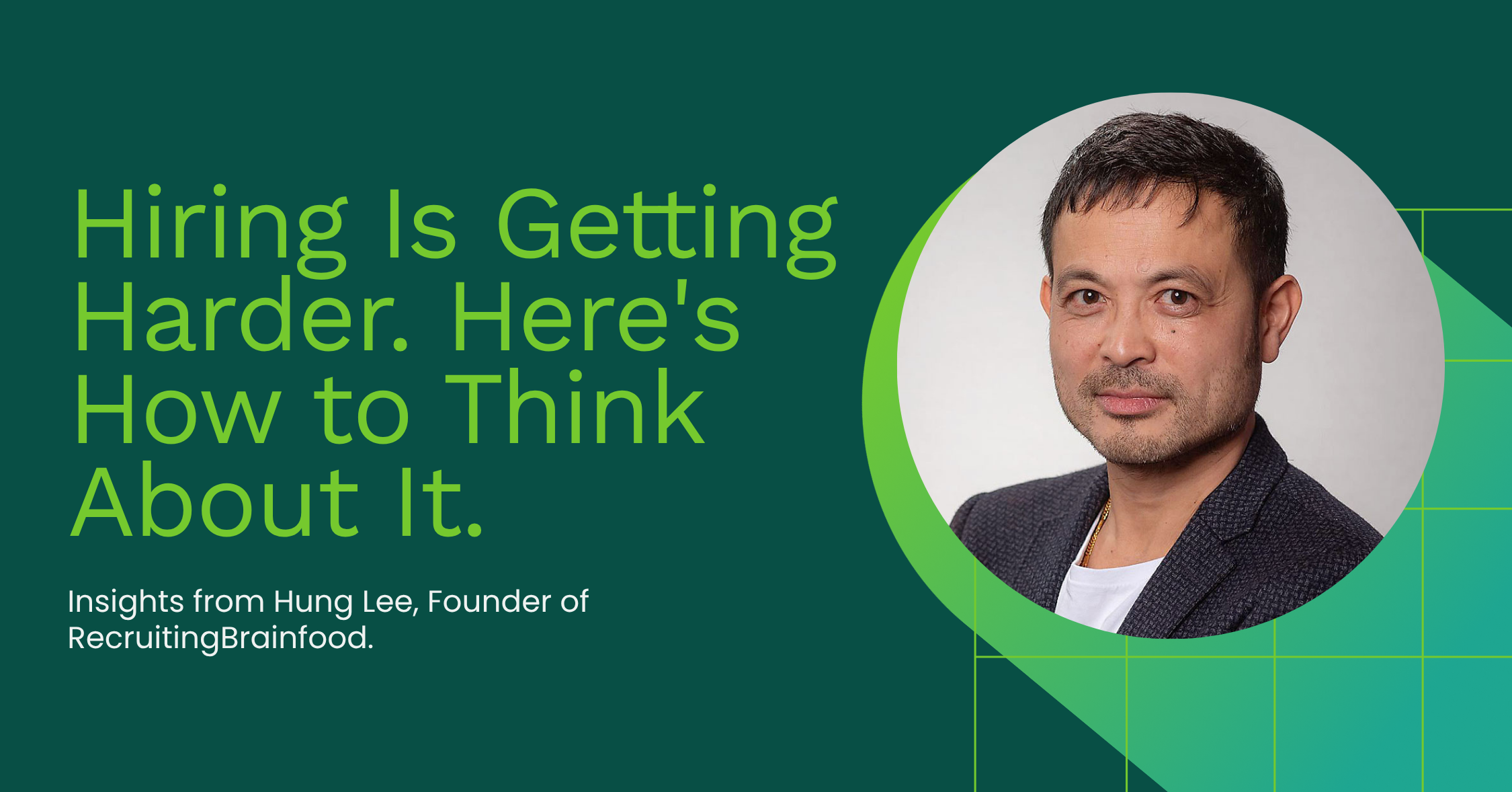
We sat down with Hung Lee, curator of RecruitingBrainfood, in London recently. Not to get predictions. To get clarity. Here's what actually came out of that conversation.
You need to do more of this yourself. Not less.
Here's something counterintuitive about where recruiting is heading.
AI is going to make it possible for non-specialists to recruit effectively. Which sounds like good news — and it is, in some ways. But what it also means is that the activity of recruiting disperses across the business. Fewer specialists. More of it falling to founders and hiring managers directly.
The muscle you're building right now doing your own outreach, running your own conversations, making your own calls on people? That's not a phase you'll grow out of. You'll need it longer than you probably expect.
Stop outsourcing the final call.
Every recruiting tool being sold right now includes "humans in the loop" somewhere in the pitch. It's meant to be reassuring. But Hung has been bothered by it, because we've accepted the phrase without really asking what it means in practice.
Specifically: what happens when the AI recommends one candidate and you want to go a different direction?
His answer was direct:
"We have to accept that this person can consistently exercise their judgment, even if they're wrong. Even if it's a bad decision."
He's not arguing for careless hiring. He's arguing for something more fundamental — the moment you start requiring justification for every override of an AI recommendation, you've handed authority somewhere it probably shouldn't go.
Some of your best early hires won't look right on paper. You'll hire them because of something you saw in a conversation, something hard to articulate. That's real information. It just doesn't come with a label.
Use AI for scheduling, for interview notes, for managing volume. Those are areas where it genuinely helps. But the decision on the people who are going to shape the direction of your company? Keep that one.
The application flood isn't coming. It's already here.
Hung put it plainly: "A motivated job seeker who was really on it could maybe make 150 to 200 applications a week... Now they could do that in half an hour."
And every single one can be perfectly tailored to the job description.
The numbers back this up. According to Gartner, 4 in 10 candidates are already using AI during the application process — primarily to write resumes, cover letters, and assessment responses.
And it's not just volume. A Gartner survey of 3,000 candidates found that 6% admitted to outright interview fraud, either by posing as someone else or having someone else interview as them.
Gartner now predicts that by 2028, 1 in 4 candidate profiles worldwide will be fake. Companies like Google and Cisco have already started bringing back in-person interviews in response, as reported by the Wall Street Journal.
For founders, that means two things.
If you're advertising roles publicly, you need AI on your end to screen what's coming in. There's no human-only solution that scales.
For your most important hires, consider not advertising publicly at all. Direct sourcing, referrals, targeted outreach to specific people you've identified. A warm intro still carries more signal than a thousand optimized applications, and that's not changing anytime soon.
Do you have a talent strategy, or just a hiring plan?
Most early founders have a hiring plan. Who do I need, when, what's the budget.
A talent strategy is the question underneath that. What skills and behaviors does this company actually need to be competitive? Where are the gaps? Which ones do you close by hiring, and which ones do you close by developing the people already here?
The difference shows up fast. A hiring plan tells you what role to open. A talent strategy tells you whether the people around you are set up to get you where you're going. At early stage, getting that clarity changes everything downstream.
Being out there is a hiring strategy.
This one's easy to deprioritize when you're heads-down. But before your company brand means much to anyone on the outside, people are deciding whether to join based on you. Your reputation, how you communicate, what working with you would actually feel like.
Hung's take on employer branding was simple: "It's not content, it's conversation — and conversation is what grabs people."
He shared a story about a founder who, when he had a tough role to fill, published a deliberately incomplete job description and asked his network to fill in the gaps. Everyone who engaged was already a domain expert. He got market feedback, real conversation, and a shortlist building in real time, all at once.
People are exhausted by polished, AI-generated everything. A real person talking honestly about what they're building cuts through in a way a perfectly optimized job post can't. If you're in a hiring cycle and not talking about it publicly, you're leaving candidates on the table.
The anxiety a lot of founders feel about hiring right now is legitimate. The tools are changing fast, the signals are harder to read, and teams are smaller so every seat matters more.
What Hung kept coming back to is less about any specific tool and more about staying clear on which decisions stay yours. Where AI helps, use it. Where it doesn't, don't hand it over just because it's easier.
That's always been the job. It just looks a little different now.