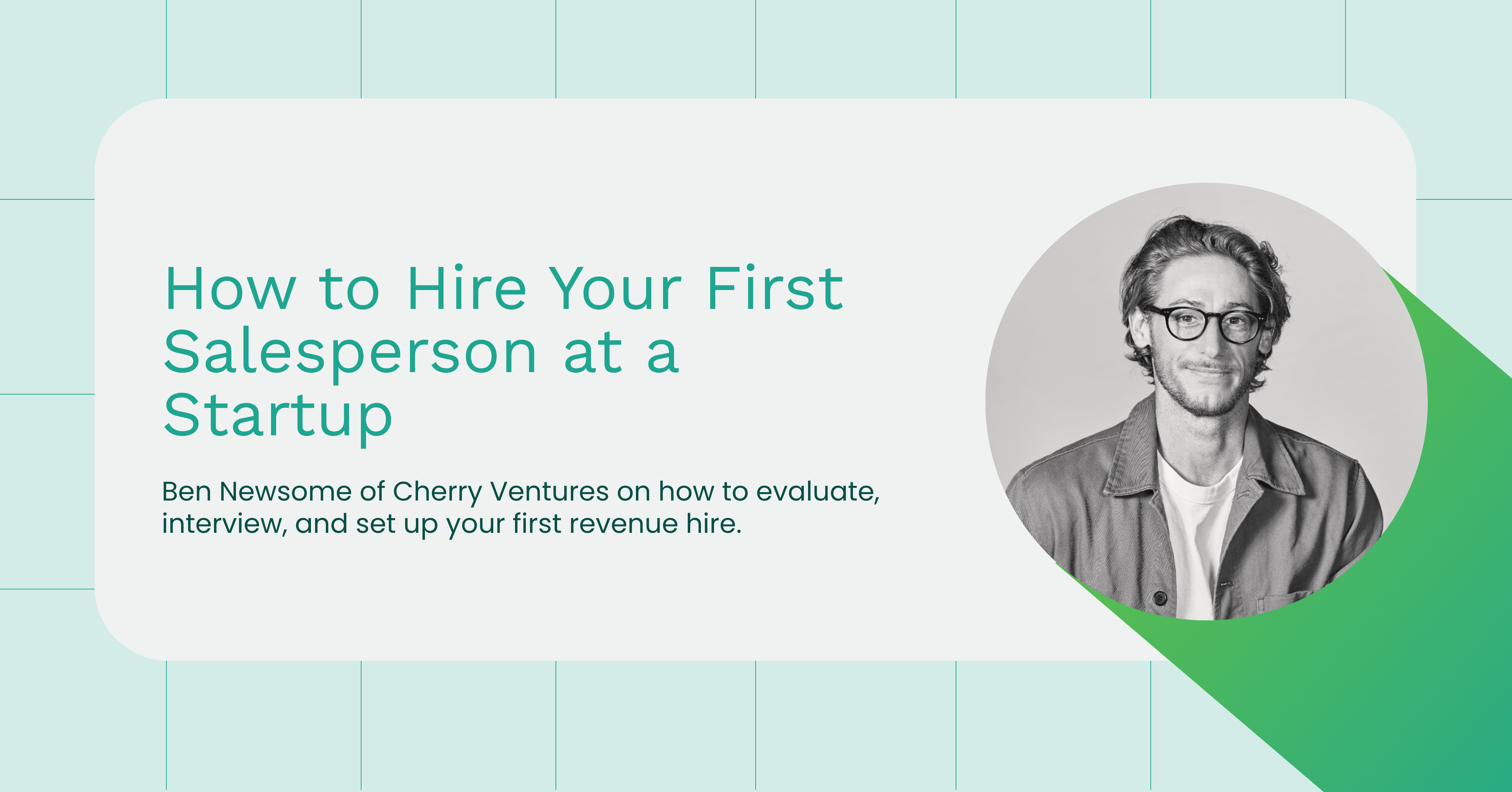
Two companies in Ben Newsome's portfolio took down rounds because of one hire.
Not because the product was wrong. Not because the market shifted. Because the first revenue-generating hire came in with strong opinions about how go-to-market should work, those opinions didn't match what the business actually needed, and by the time anyone caught it, six to twelve months of runway were gone.
Ben has watched this play out across hundreds of early-stage companies. He spent years inside the talent function at Octopus Ventures and now leads talent at Cherry Ventures. We chatted with him on Human First, and he was direct about how often this hire gets miscalled and what founders can do to avoid being part of that statistic.
If you don't come from a sales background and you're about to make this hire, this is the order of operations he'd walk you through.
Stress-test your go-to-market before you write the role
Most founders skip this step because they assume they already know what's working. The relationships they've built, the deals they've closed, the pitch they've refined. It feels like the answer is in their head.
Ben's pushback: stress-test it anyway.
Bring in an advisor, a fractional sales leader, or a peer founder one round ahead. Pressure-test your assumptions about who the customer actually is, what they're buying, and where the motion is working versus where it's working because you are the one doing it.
The hire is meant to scale past where you, as a founder, can personally take the business. If you're hazy on what's working and why, you'll write a vague role description, attract a vague set of candidates, and have no way to evaluate fit.
The audit also surfaces gaps in the role itself. Sometimes founders go in thinking they need a seller and discover they need more strategic range. Sometimes it's the reverse. The audit tells you which.
Decide whether you need a hungry seller or a strategic operator
Both are valid hires. They're different people.
If your motion is mostly working and you need someone to scale it, you probably want a hungry seller. Someone with high activity, strong closing instincts, and the discipline to run reps against a tested pitch.
If the motion is still finding its lane and you're closer to product-market fit than past it, you might need someone with more strategic range. Someone who can iterate on positioning, run experiments, and bring a point of view about the go-to-market.
Ben defaults to the hungry seller as the first hire in most cases, but flagged that defaulting without thinking is where founders get into trouble. Same job title, different people, very different outcomes.
Weight behavior at 75%, experience at 25%
Here's the line that should anchor the rest of your process: "We tend to lean probably 75% into attitude and behavior and 25% into experience and skill set."
For a hire this consequential, that ratio sounds reckless. Founders without a commercial background tend to weight it the other way. They look for the most relevant logo, the highest quota attainment, the cleanest growth narrative.
The reason is structural. A seasoned seller from a Series C company has been operating inside a system. The territory was defined, the pitch was tested, the objections were known, marketing was generating leads. That seller may have been excellent inside that system. None of that tells you whether they can build one from scratch.
As Ben put it:
"You can really hide in big businesses. And you can be lucky in where you fall in that business, whereby the results actually overlook the competence of that person."
The behaviors that matter at this stage: resilience, bias to action, tolerance for ambiguity, self-starter energy. The willingness to wear multiple hats and operate outside a defined scope. Conviction held loosely enough to change course when the product, the market, or the ICP shifts.
Translated: someone who genuinely likes the messy part. Someone who has done it before, in practice, inside a company small enough that there was nowhere to hide.
Interview for the messy parts of the story
Skip the hypotheticals about how they'd approach building a sales motion at your stage. Sellers are good at sounding strategic about hypotheticals. Ask about situations they actually faced, with the messy parts intact.
What did they own? How did they handle conflict with the founder or executive team? When the strategy was wrong, how did they figure that out and what did they do about it? What did they take accountability for that wasn't in their job description?
The trap here is what we call "happy ears." Sellers are good at selling themselves. They'll pattern-match to what you seem to want and reflect it back to you. The way through is to keep asking for evidence. Specifics over adjectives. What were the numbers before they got there? What were they after? Which of the changes in between did they drive?
Look for repeat early-stage operators. Someone who has lived through ambiguity, taken accountability when things broke, and still wants more of it is sending a signal no interview answer can replicate.
Reference the people who weren't on the list
Ben flagged this as one of his real pet peeves: founders who run a great process and then phone in two reference calls with names the candidate handed them.
Backchannel the references. Use your network, the investor's network, LinkedIn. Find the people who managed this person, peered with this person, or reported to this person who weren't named on the list. Conversations get more honest when the candidate didn't pre-stage them.
The questions worth asking on those calls:
- What did this person actually own versus what did the system around them own?
- How did they handle it when something broke?
- Would you hire them again at an earlier stage than where you worked with them?
That last one is the test. Plenty of people are good at a stage. Fewer are good at the stage before it.
Share the deals once they're in the seat
The hire only works if you, the founder, change your behavior too.
Ben was direct about this:
"There has to be some maturity with founders around this, you know, the ability to relinquish some control and pass on opportunity."
The pattern he sees often: founder hires a great seller, sets a high quota, then keeps taking the brand-name deals and high-stakes accounts personally. The new hire is left chasing smaller, harder opportunities without the founder's relationships behind them. They miss quota. The founder concludes they hired wrong. The seller leaves. Everyone loses six months.
You're still the lead seller for a while. That part doesn't change overnight. But the deals, the relationships, and the credibility have to start flowing to the person you brought in, or the role was never going to work.
The first sales hire is a partnership that gradually shifts weight from you to them. Founders who treat it that way get the graduation to Series A. Founders who don't get the down round.
Listen to the full conversation with Ben Newsome on Human First, available wherever you get your podcasts.