For the better part of two decades, SaaS founders have followed a familiar playbook for building sales teams.
Hire SDRs to generate pipeline. AEs to close deals. Customer success managers to handle the relationship after the sale. As the company grows, add more people to each function.
It's a model that's shaped how an entire generation of software companies hire, structure, and scale their revenue organizations.
But AI is starting to change some of the assumptions that made that model work in the first place.
And according to Mark Roberge, we may be heading back toward something that looks a lot more like the sales organizations of 30 years ago.
Mark has an interesting perspective on this. As HubSpot's founding CRO, he helped take the company from zero revenue to IPO and wrote The Sales Acceleration Formula, one of the defining books on building a scalable, data-driven sales organization. Today, he's the co-founder of Stage 2 Capital, where he works closely with early-stage companies figuring out how to build their own go-to-market engines.
When we spoke on the Human First podcast, he made the case that AI could bring back the full-cycle salesperson. And if he's right, it has some pretty significant implications for how founders think about their next sales hire.
How we got to the specialized sales team
Before the SaaS boom, being a salesperson often meant owning the entire customer relationship.
You found your prospects, booked your meetings, closed your deals, and managed those accounts afterward. There weren't separate teams responsible for each stage.
That started to change in the early 2000s. Aaron Ross's work at Salesforce, later documented in Predictable Revenue, helped popularize the specialized sales model that became standard across SaaS.
And there were good reasons for it.
Prospecting and closing require different skills. Specialization allowed companies to hire for specific strengths, train people on a narrower set of responsibilities, and build more predictable processes around each stage.
But there were tradeoffs.
A prospect might build a relationship with an SDR, only to get handed off to an AE, then handed off again after becoming a customer.
The incentives also became more complicated. SDRs are measured on meetings booked. AEs are measured on deals closed. Customer success teams are responsible for retention.
Each person can be doing their job well according to their own metrics, while the overall customer experience suffers.
As Mark pointed out, those tradeoffs have always existed. AI is changing how much weight we should give them.
AI could bring back the full-cycle salesperson
The argument for specialization has always depended, at least in part, on the limitations of what one person can reasonably do well.
A great closer might struggle with prospecting. Someone who's excellent at building relationships might be less effective at the administrative and operational work that comes with managing a large book of business.
AI is starting to make those gaps less consequential.
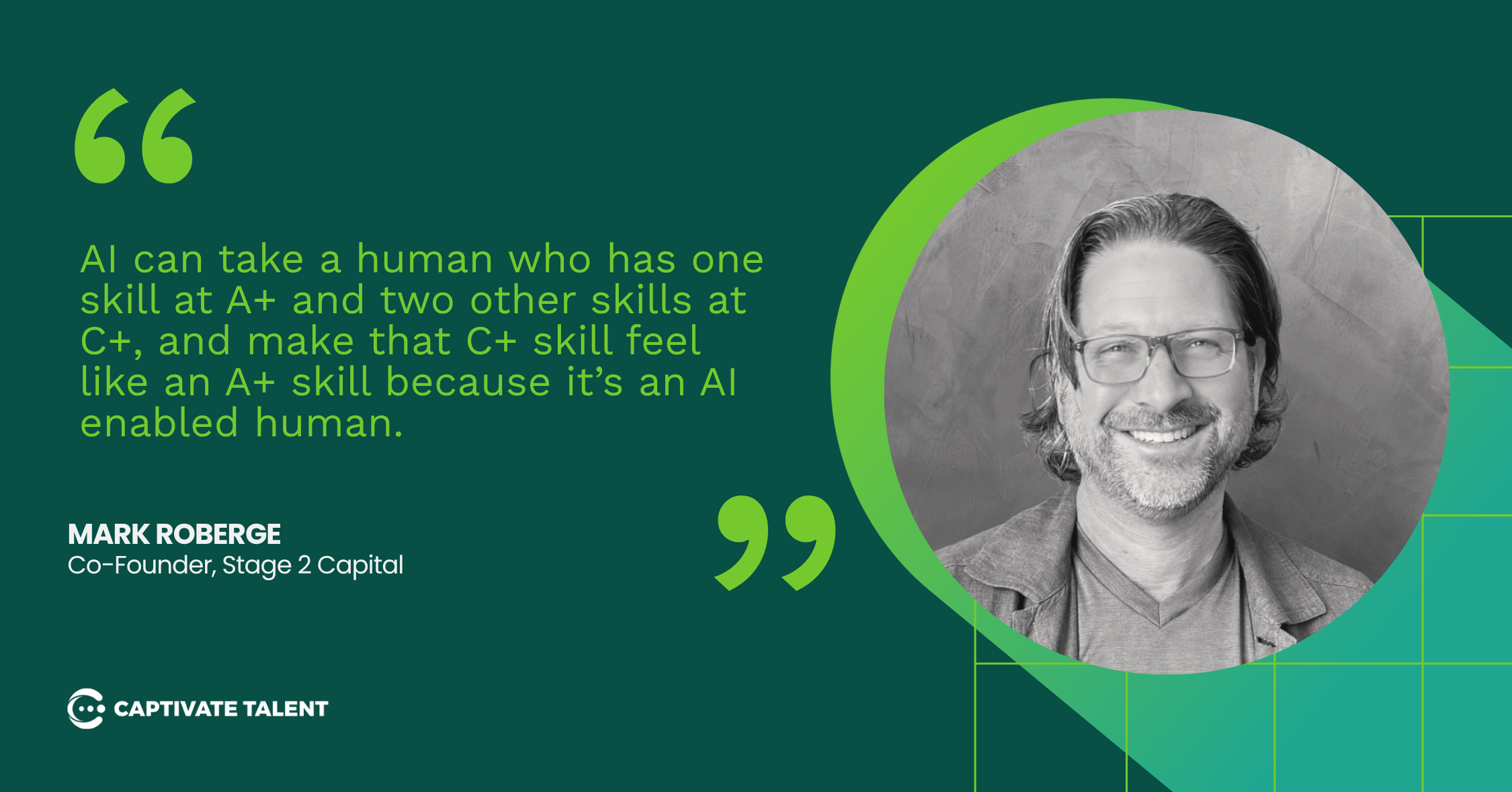
As Mark explained:
"AI can take a human who has one skill at A+ and two other skills at C+, and make that C+ skill feel like an A+ skill."
Think about what that means for a salesperson who's exceptional at discovery, building relationships, and closing deals.
With AI supporting account research, prospect identification, outreach preparation, CRM updates, and meeting follow-up, that person can potentially take on much more of the sales cycle themselves.
Mark believes this could make the full-cycle salesperson, someone who owns the relationship from initial outreach through renewal and expansion, a much more attractive option.
And there's a benefit for the customer, too.
Instead of being passed between several people, they work with someone who understands their business, remembers the earlier conversations, and has a vested interest in the long-term success of the account.
What happens when selling time doubles?
One of the most interesting points Mark raised was about a metric that doesn't get nearly as much attention as pipeline or quota attainment: selling time.
Selling time is the number of hours a salesperson actually spends with prospects and customers.
According to Mark, even best-in-class salespeople have historically spent only about 15 hours per week doing that work.
The rest goes toward researching accounts, preparing for meetings, running outreach sequences, updating the CRM, reviewing pipeline, and handling everything else that comes with the job.
He believes AI could increase that number from 15 to 30 hours per week.
Consider the implications.
A rep who previously had the capacity to manage 20 opportunities might now be able to manage 40. Same person, same compensation, same product, and potentially the same close rate.
In Mark's example, a rep producing $800,000 in annual sales could theoretically produce $1.6 million simply by having more time to sell.
He estimates that the top 2% of sales teams are already operating at this level, though the broader market is still early.
Of course, doubling selling time doesn't automatically mean doubling revenue. The quality of those conversations, the available pipeline, and the rep's ability to manage a larger workload still matter.
But the potential change in capacity is significant.
For founders, it raises an interesting question: if one salesperson can spend twice as much time with customers while AI handles much of the supporting work, how does that change the number and types of people you need to hire?
The skills that matter most in a sales hire are changing
If AI can make someone substantially better at research, preparation, and administrative work, founders have an opportunity to rethink what they're screening for.
Mark's view is that the most valuable skills in this next phase will be the human ones.
The ability to run a great discovery call. Understand what a buyer is really saying. Ask the right follow-up question. Build trust and manage a relationship over time.
Those skills become especially important when you're asking one person to own more of the customer journey.
It also means the way we evaluate candidates needs to evolve.
Mark shared how he's changing his approach to sales and sales management interviews.
Previously, a candidate might be asked to prepare a presentation or analyze a recorded sales call and submit a coaching plan.
Today, AI can produce a pretty convincing version of either.
So Mark has shifted the evaluation toward the actual work. Sales candidates participate in live roleplays. Management candidates have to coach a salesperson, rather than simply present a coaching plan.
And he actively encourages them to use AI to prepare.
He wants to see whether candidates can take that preparation and translate it into a strong customer conversation or a useful coaching session.
For founders hiring sales talent, that's an important distinction. A candidate's ability to produce impressive work with AI tells you something. Watching them put that work into practice tells you a lot more.
We explore this further in our guide to hiring AI-native sales talent, including what to assess and how to structure interviews.
You don't have to rebuild your sales team tomorrow
For all the potential Mark sees in full-cycle selling, he's also clear that we're still figuring out how these roles should work.
The technology is moving quickly, but the processes, hiring profiles, and organizational structures around it are still developing.
For startups under pressure to scale, he recommends keeping the proven sales motion running while building a parallel effort to experiment with AI.
That might mean testing a full-cycle role alongside your existing SDR and AE structure, with strong RevOps support to help design and measure the process.
The goal is to learn what actually works for your business before making major organizational changes.
There will still be situations where specialization makes sense. Complex enterprise sales, for example, may require expertise and support that one person can't reasonably provide.
And companies with highly effective product-led growth motions may need an entirely different approach.
The important thing is to make those decisions based on how your customers buy, what your team needs to accomplish, and what AI can realistically enable today.
Rethinking the next sales hire
The specialized sales model has helped thousands of SaaS companies scale. There's a reason it became the default.
But the technology that shaped how those teams operated is changing, and founders now have more options for how to build them.
Maybe your next hire is an AE who can own prospecting and closing. Maybe it's a full-cycle seller who can manage the customer relationship from the first conversation through expansion. Or maybe your current structure is working well, and the immediate opportunity is simply giving your existing team more time to sell.
The opportunity is to be more deliberate about the sales organization you're building, rather than assuming the next stage of growth requires another layer of specialization.