At some point, founder-led sales starts to feel unsustainable.
You're running demos, following up with prospects, negotiating deals, and trying to build a company at the same time. Revenue is coming in, but so much of it still depends on you being in the room.
Hiring your first salesperson feels like the natural next step. Someone who can take ownership of sales, build pipeline, and give you back time to focus on the rest of the business.
But there's an important question to answer before you make that hire: Have you figured out how to sell your product in a way someone else can repeat?
Harrison Rose, co-founder of Paddle and Good Fit, has thought about this a lot. He helped scale Paddle to a unicorn valuation and is now applying those lessons to building his second company.
His advice for founders considering their first sales hire is pretty straightforward. Before you hire someone to sell your product, you need to understand what actually makes it sell.
Your first salesperson needs something to repeat
Harrison spent Paddle's early years doing nearly every go-to-market job himself. Sales development, account management, solutions engineering. He learned each function by doing it before bringing someone in to take it over.
Part of that came from inexperience. He was 18, building his first company, and didn't necessarily know what expertise he could hire.
But that approach also forced him to figure out how the business worked before asking someone else to do it.
His advice to founders today is to get to the point where selling your product feels almost predictable.
"It needs to be so repeatable that it's completely f***ing boring to you."
You know which customers are likely to buy. You understand the problems that get their attention, the objections that come up, and what moves a deal forward. You've had enough similar conversations that you can start to recognize a process someone else could follow.
That doesn't mean every deal will look identical, or that you need a perfectly documented sales playbook.
It means you've established enough consistency that you're hiring someone to execute a process you understand.
Without that foundation, you're asking a new salesperson to discover how your business sells while simultaneously holding them accountable for revenue.
Founder privilege can hide what's actually working
One of the more interesting ideas Harrison discussed was something he calls founder privilege.
As a founder, you have advantages in a sales conversation that are difficult to transfer to someone else.
You know the product inside out. You can negotiate pricing on the spot, make commitments about the roadmap, and answer technical questions without needing to check with another team.
You also have a level of credibility that comes from being the person who built the company.
A salesperson doesn't have all those advantages.
They're selling the product as it exists today, within pricing guidelines and whatever authority you've given them. They may know the product well, but they can't make every decision on the fly.
This creates a challenge when you're evaluating whether your sales process is ready to hand off.
You might be consistently closing deals, but how much of that success depends on your involvement?
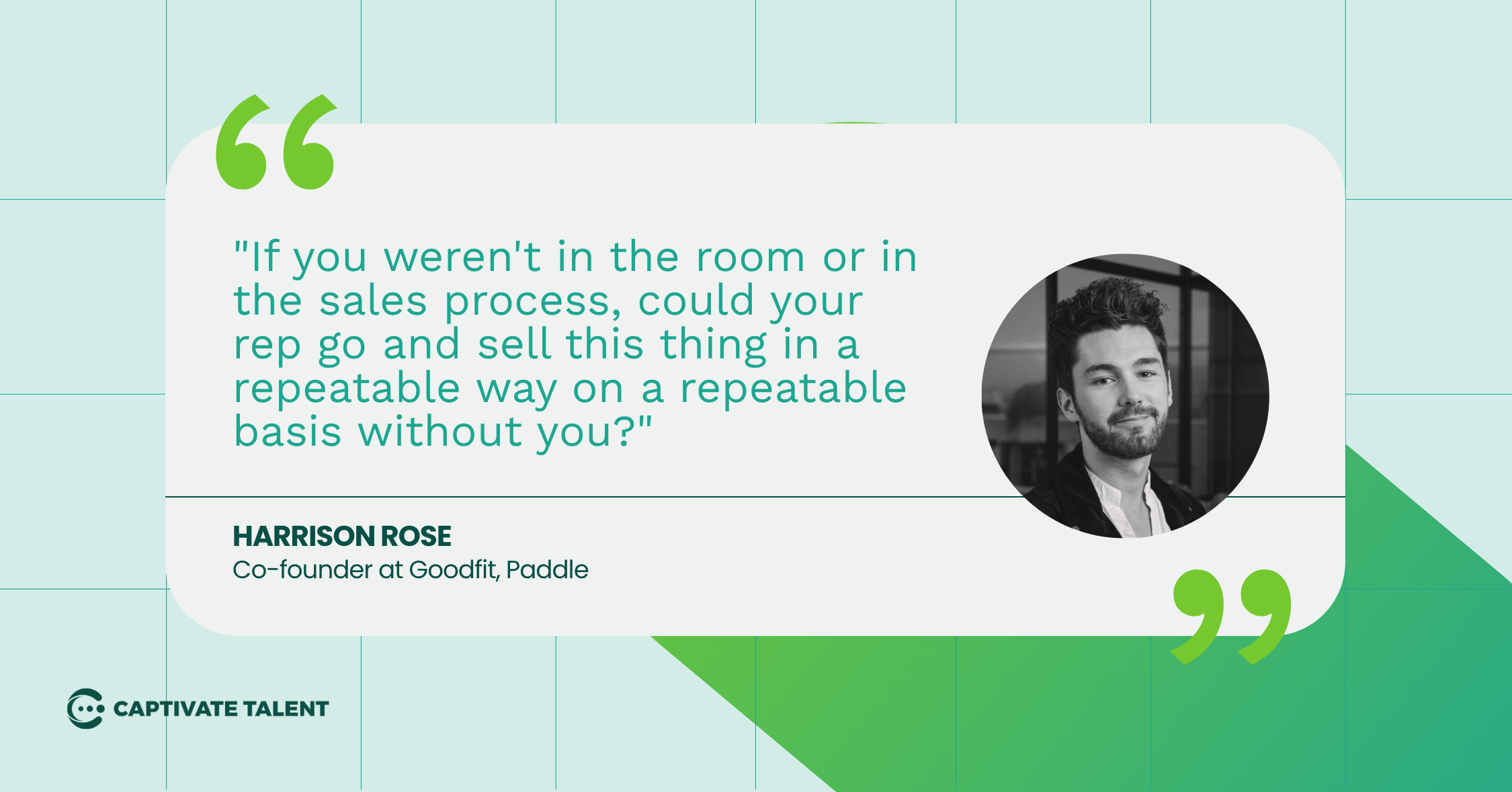
Harrison offered a useful test:
"If you weren't in the room or in the sales process, could your rep go and sell this thing in a repeatable way on a repeatable basis without you?"
If the answer is unclear, that's worth investigating before hiring.
Look at your recent wins. Which deals depended on custom pricing, personal relationships, or product commitments that another salesperson couldn't make? Which ones followed a process you could realistically teach?
The difference tells you a lot about how ready your business is to move beyond founder-led sales.
Your ideal customer needs to be specific enough to sell to
Knowing your ideal customer is another important part of building a repeatable sales motion.
Harrison shared an example from Paddle's early days.
He could have described Paddle's target market as software companies with 50 to 250 employees in North America and Europe.
That description was accurate. It also left him with tens of thousands of potential customers and very little guidance about where to spend his time.
The more useful definition came from understanding which companies would get the greatest value from Paddle.
They were software businesses selling through an online checkout, particularly those serving international customers who needed help managing currencies, payment methods, and taxes.
That distinction changed how Paddle approached outbound sales.
Instead of targeting every software company that met a basic set of criteria, Harrison could identify companies with international demand that weren't yet equipped to serve those customers effectively.
He could prioritize accounts based on a specific problem Paddle was well positioned to solve.
For a founder preparing to hire their first salesperson, this matters enormously.
A broad ICP gives a new hire a market to explore. A well-defined ICP gives them a starting point for deciding who to contact, what to say, and why someone might buy.
Before hiring, ask yourself whether you can explain which customers are most likely to buy and what makes them different from everyone else who technically qualifies.
You might need a different kind of first hire
There's an important distinction in Harrison's advice.
Some founders have established a sales motion and need someone to help execute it. Others are still figuring out how to consistently reach the right customers.
Those situations call for different kinds of help.
If you've established repeatable demand and need someone to manage more opportunities, a founding account executive may make sense.
But if you're still experimenting with positioning, outbound channels, and how to generate pipeline, Harrison suggests considering a growth-oriented hire who can work alongside you.
Someone who can run structured experiments, test different approaches, and help establish the go-to-market motion.
The distinction matters because the expectations are different.
An AE is typically hired with a revenue target and an expectation that they'll generate or close business. A growth-oriented hire working alongside the founder may be responsible for figuring out which approaches are worth investing in.
And as AI takes on more of the research, prospecting, and outbound work, the skills founders should look for are changing, too. We explore those shifts in our guide to hiring AI-native sales talent.
The right first hire depends on what your business has already figured out and where you need help.
For a deeper look at evaluating candidates once you're ready, see our guide to hiring your first salesperson.
Make sure there's enough opportunity for them to succeed
Even with a repeatable process, hiring a salesperson creates a new set of responsibilities for the founder.
At Paddle, Harrison learned this through a difficult experience.
The company was growing rapidly, at one point tripling revenue year over year. But its internal growth targets were even more aggressive, and the sales team felt like it was consistently falling short.
Over several months, most of that team left.
Looking back, Harrison recognized that the company hadn't created the right conditions for individuals to understand their performance or feel successful. Salespeople were measured against a shared company target rather than individual quotas.
The experience changed how he approached leadership, performance expectations, and planning.
It also reinforced the importance of understanding how much work a sales team can realistically handle.
Before bringing in your first salesperson, you need some idea of where their opportunities will come from, how much pipeline they'll need, and whether the business can support their targets.
And those expectations should inform how you evaluate candidates in the first place. Our conversation on how to stop vibe hiring and build a sales team that scales explores how to bring more structure to that decision.
A great salesperson can still struggle if there isn't enough opportunity or the expectations are disconnected from what's achievable.
So, when should you hire your first salesperson?
There's no universal ARR milestone that tells you it's time.
You might be ready at $500K ARR. You might reach $2M and still have work to do before handing sales over to someone else.
The more useful question is whether you understand your customers, have a sales process that produces consistent results, and can give someone else a reasonable opportunity to repeat it.
And if you're not quite there, you can still bring in help. You may simply need someone who can work alongside you to figure out the motion before hiring someone to scale it.
Harrison's experience is a reminder that the founder's involvement in sales serves a purpose beyond bringing in early revenue. It's how you learn what works well enough to eventually hand it over.
The clearer you are on that process, the better positioned your first sales hire will be to succeed.