You've reached the point where you know you need marketing leadership. Maybe you've been running marketing yourself, or you've got a small team that's doing good work but needs someone to set the direction. Either way, you're ready to bring in someone who can take ownership of the function.
But what does that person actually look like?
Do you need a CMO? A VP of Marketing? Someone who's scaled a marketing organization at a successful SaaS company? Or someone who's built the function from scratch a few times?
And with AI changing how much a small marketing team can accomplish, how should that factor into the decision?
We recently had Kathleen Booth, VP of Marketing at Sequel and former SVP of Marketing at Pavilion, on the Human First podcast to talk about exactly this.
Kathleen has built and led marketing teams across B2B technology companies, and she recently made a deliberate move into a smaller company where she could build an AI-first marketing organization from the ground up.
Her perspective offers a useful way to think about one of the most consequential hires an early-stage founder will make.
The title doesn't tell you what you need
There's a natural appeal to hiring an experienced CMO, particularly someone who's helped grow a recognizable SaaS company.
But the day-to-day responsibilities of a CMO at an established company can look very different from what an early-stage business needs.
At a larger organization, a marketing leader may spend much of their time managing specialized teams, setting strategy, representing the brand, and coordinating across departments. They have people responsible for executing the work.
At a Seed or Series A company, that infrastructure probably doesn't exist yet.
Your marketing leader might be responsible for setting the strategy in the morning and building a campaign in the afternoon. They may need to write positioning, test acquisition channels, manage contractors, and figure out which investments are actually generating pipeline.
Kathleen has held CMO positions before, but deliberately took a VP title at Sequel because it reflected the work the company needed at its current stage.
As she explained:
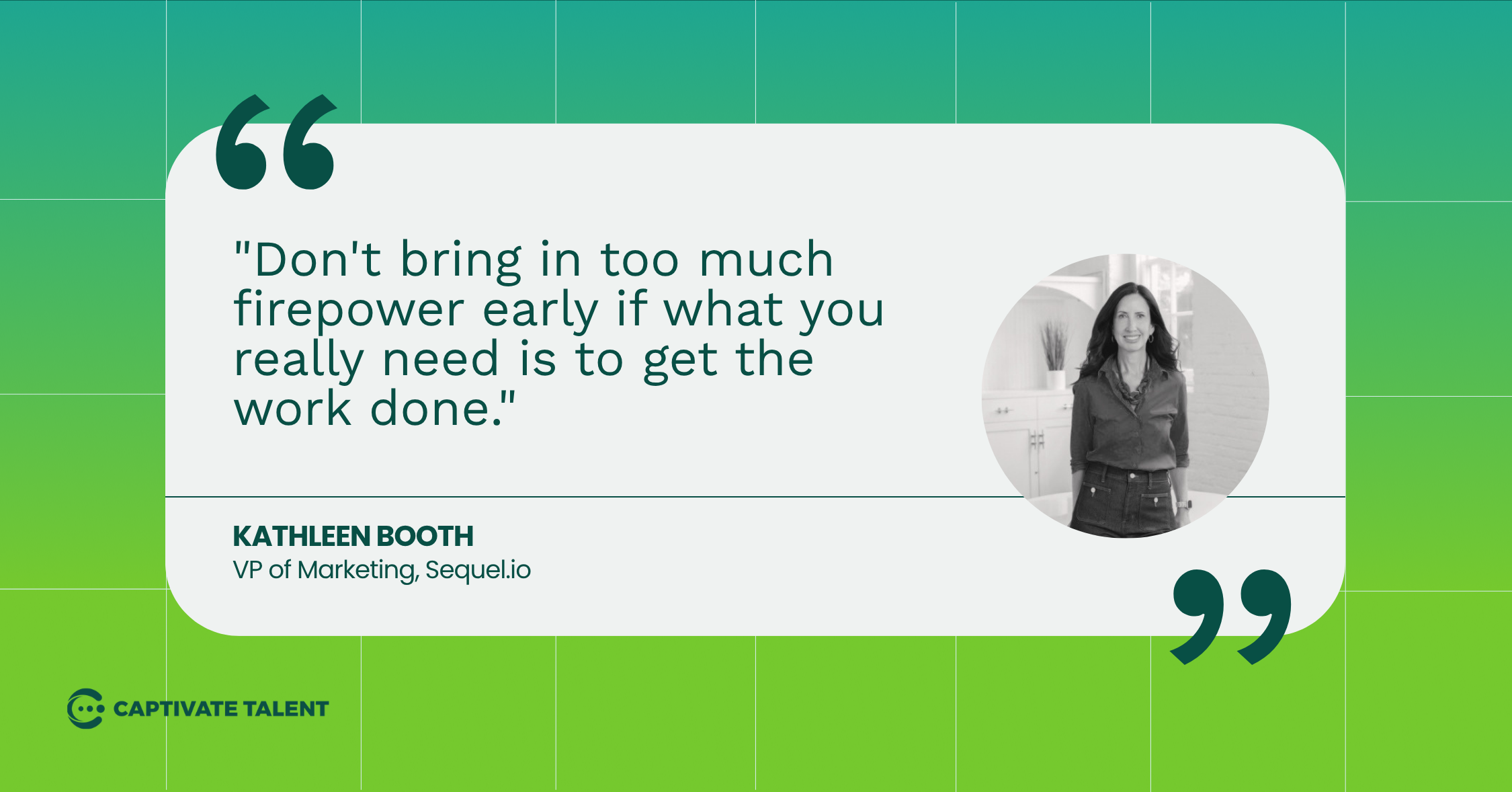
"Don't bring in too much firepower early if what you really need is to get the work done."
The distinction matters because seniority and scope aren't always the same thing.
A highly experienced marketing leader can be exactly the right person for an early-stage company, provided they want to operate in that environment and have the skills to do so.
Before settling on a title, get specific about how this person will actually spend their time.
Experience at a big company doesn't always translate
A candidate who has helped scale a well-known SaaS company brings valuable experience. They've seen what growth looks like, worked with sophisticated teams, and probably developed strong instincts about what works.
The question is how much of that experience translates to your current environment.
Kathleen made an interesting observation about accomplished marketing leaders: sometimes the companies they worked for had exceptional products and strong product-market fit.
That doesn't diminish their contributions. But it does make it harder to separate the impact of the marketing leader from the conditions that helped make the company successful.
Someone who has scaled an existing growth engine may be excellent at optimizing it. Building that engine when the playbook is still being figured out requires a different set of skills.
We've seen this distinction come up in our own searches, too. In one VP of Marketing search, a candidate with an impressive background at a recognizable company struggled to adapt to the realities of an early-stage business. It's an example of what we've called the perfect fit hiring trap: a strong resume can make someone look like an obvious fit, even when the environment they'll be working in is very different.
Kathleen described looking for people with a high "figure it out factor." They're comfortable encountering problems they haven't solved before, experimenting with possible solutions, and making progress without waiting for detailed instructions.
That quality is particularly valuable when there are fewer resources and established processes to fall back on.
When evaluating candidates, look beyond the companies on their resumes.
Ask what the marketing organization looked like when they joined. What resources did they have? What did they personally build? How did they approach problems when there wasn't an existing playbook?
You'll learn more about their fit for your stage than you will from the logos alone.
AI is changing what your first marketing hire needs to do
AI introduces another consideration into the hiring decision: how much work can a smaller team reasonably accomplish before adding specialized headcount?
Kathleen shared a practical example from her first six months at Sequel.
When she joined, the company was considering hiring a product marketer. Rather than immediately filling the position, she suggested waiting.
She wanted to see how far she could get with herself, an existing demand generation marketer, and AI.
For six months, Kathleen personally ran product marketing, using AI to make the work more efficient. Along the way, she learned which responsibilities she could handle and where she was beginning to reach her limits.
Once those limits became clear, she had a much better understanding of what the new product marketer actually needed to own.
That distinction is becoming increasingly important for early-stage teams.
AI can help a marketing leader take on work that previously might have required additional people or outside resources. But someone still needs to understand the marketing fundamentals, make decisions, and evaluate the quality of what's being produced.
For a founder hiring their first marketing leader, that means looking for someone who can work hands-on with AI and exercise strong judgment about where it helps.
We've explored this shift in more detail in our guide to hiring AI-native marketing talent, including how to evaluate candidates who combine strong marketing fundamentals with practical AI skills.
AI also creates an opportunity to be more deliberate about subsequent hires.
Rather than building out the marketing org chart based on what similar companies have historically done, you can identify where the work genuinely requires deeper expertise.
Know what you're asking marketing to accomplish
One of the most useful parts of our conversation came when we asked Kathleen what founders should be honest with themselves about before beginning a marketing leadership search.
Her answer was immediate: budget and results.
A strong marketing candidate is going to want to understand what success looks like, how much pipeline they're expected to generate, and what resources they'll have to accomplish it.
Those expectations need to be connected.
Kathleen described the challenge of founders setting aggressive growth targets without a corresponding increase in marketing investment, sometimes assuming AI will make up the difference.
Her response was pretty direct:
"You're looking for a magician, not a marketer."
AI can create efficiencies, but it doesn't eliminate the need for realistic assumptions about what it takes to generate growth.
A good marketing leader should be able to work with you to understand historical performance, acquisition costs, conversion rates, and where additional investment could make a difference.
And if they challenge your assumptions during the interview process, that's often a good sign.
Product-market fit matters here, too.
If you're still working toward it, marketing may need to focus heavily on experimentation, customer understanding, and figuring out which messages and channels generate traction.
If you've established product-market fit and have a repeatable sales motion, the mandate may be to build a more consistent, scalable pipeline engine.
Those are different jobs, and they require different strengths.
The clearer you are about your starting point and expectations, the easier it becomes to identify someone equipped to deliver.
Start with the problem you need solved
Marketing covers a lot of ground, which makes hiring a leader particularly challenging for founders who haven't worked in the function themselves.
Kathleen suggested identifying which area of marketing needs to be your new leader's greatest strength.
In most early-stage companies, that comes down to some combination of demand generation, product marketing, and brand.
If your biggest challenge is generating enough qualified opportunities, you may need someone with deep demand generation expertise.
If you have a strong product but customers struggle to understand what it does or why they need it, product marketing may be the more immediate priority.
Brand becomes increasingly important as you establish your position in a category and work to build broader awareness and preference.
Your first marketing leader will probably need to contribute across all three. But expecting someone to be equally exceptional at everything makes an already difficult search harder.
Knowing where they need to be strongest gives you a much clearer way to evaluate candidates.
It also helps you have a more productive conversation about what they'll own personally, where they'll need support, and how the role might evolve as the company grows.
The right hire needs to work with you, too
There's one final point Kathleen raised that's easy to overlook when you're focused on experience, skills, and results.
The relationship between a founder and their marketing leader depends heavily on trust.
Marketing requires a lot of judgment calls, especially in the early stages when you're still testing what works. Your marketing leader needs to be comfortable challenging your assumptions, and you need to trust them enough to let them do their job.
Kathleen put it this way:
"That is the number one success factor, in my opinion, between CEOs and CMOs is the trust and the relationship."
A candidate can have an impressive background and all the right technical skills, but if you can't communicate openly or work through disagreements productively, it's going to be a difficult partnership.
As you prepare to make this hire, spend time getting clear on the work your business needs done today and what you expect that work to become over the next year or two.
The right marketing leader for your company today may look very different from the person you'd hire three years from now.
And that's exactly how it should be.