There's a lot of pressure on go-to-market teams right now to do more with AI.
Sales reps are building their own prospecting agents. RevOps teams are automating enrichment and account prioritization. Founders are looking at workflows that used to take hours and wondering how much of that work can be handed over to a machine.
And in many cases, the technology works. Research happens faster. More accounts get enriched. More emails go out.
But there's a question worth asking before adding another agent to the stack: Are we confident it's doing the right work in the first place?
Elio Narciso, co-founder and CEO of Scalestack, recently joined Captivate's Human First podcast to discuss what happens when companies give increasingly powerful AI systems access to information that was never particularly reliable to begin with.
His description of the problem is memorable: AI doesn't fix bad data. It weaponizes it.
AI will confidently scale whatever you give it
Think about a typical CRM.
Some records are outdated. There are duplicate accounts, incomplete contact details, and opportunities that haven't been updated in months. Maybe the company has changed its ideal customer profile a few times, but those changes haven't been reflected consistently across the database.
None of this is particularly unusual. Even mature revenue organizations accumulate years of information collected under different strategies, processes, and definitions.
Historically, a salesperson working with that data might notice something was off. They'd recognize an account that didn't make sense, question an outdated contact, or do a little extra research before reaching out.
That process was inefficient, but it introduced opportunities for human judgment.
Now imagine hundreds of agents working from the same information, researching accounts, generating outreach, and making prioritization decisions automatically.
"If you plug bad data, it's just weaponized because the output may look credible at first, but it's based on the wrong inputs," Elio explains.
The risk grows with scale. An inaccurate record that once affected one rep's workflow can now influence thousands of automated decisions.
And because the output looks polished and authoritative, those errors can become harder to spot.
Your CRM knows your customers. Does it understand them?
For years, revenue organizations have invested heavily in systems of record.
Salesforce, HubSpot, and the rest of the GTM technology stack were built around the idea that companies needed a central place to capture and organize customer information.
That investment made sense. Having a shared source of information is enormously valuable.
But a database of customer records can only tell you so much.
Consider two companies with similar firmographic profiles. They're in the same industry, have roughly the same number of employees, and recently raised similar funding rounds.
One could be an excellent prospect. The other might have no meaningful need for your product.
Understanding the difference requires context.
What problems are these companies trying to solve? How do they operate? What signals suggest they're likely to buy? What have you learned from similar customers?
Elio describes the need for a system of intelligence, a layer that connects information from different sources with the company's strategy and helps teams determine where to focus.
For founders, the underlying principle matters more than the technology itself.
Your AI systems need access to the same business context you'd expect a strong salesperson or revenue leader to understand.
Otherwise, they're making decisions based on an incomplete picture.
Before you automate your GTM motion, get specific about your ICP
One of the more revealing observations from Elio's work is how often companies struggle to articulate their ideal customer profile.
He's encountered organizations that have raised substantial capital but still can't agree on exactly which customers they should pursue.
In conversations with private equity operators, he's heard about companies where asking ten people to define the ICP produces ten different answers.
That ambiguity becomes a much bigger problem when you introduce automation.
If every salesperson has a slightly different interpretation of the ideal customer, the team already has a consistency problem. Giving AI agents access to those competing definitions can multiply it.
And AI makes the temptation to pursue more opportunities even stronger.
When prospect research and outreach become easier, expanding into another segment can feel relatively inexpensive. You can generate a list, build a sequence, and start testing almost immediately.
But your team's attention is still finite.
Elio's recommendation is to get extremely specific about the customers most likely to succeed with your product.
That means going beyond industry, company size, and funding stage.
Think about the circumstances that make someone a particularly good customer. What is happening inside their business? What problems are becoming urgent? What distinguishes customers who buy quickly from those who spend months evaluating?
Then make sure those definitions are shared across the organization and reflected in the systems your team uses.
A useful exercise is to ask your founder, head of sales, and RevOps lead to independently describe your five best-fit customer characteristics.
If the answers differ substantially, there's valuable work to do before scaling the next automated motion.
The people you hire need to understand the whole business
As AI takes on more repetitive work, the expectations for GTM talent are changing.
Researching accounts, enriching contact records, cleaning spreadsheets, and preparing information for sales conversations have historically occupied a meaningful portion of junior sales and operations roles.
Much of that work can now be handled through a combination of AI and traditional automation.
Elio sees this changing what companies should look for when hiring, including at the entry level.
He wants people who can interact with customers, work through uncertainty, gather business context, and translate that information into instructions for automated systems.
"I want to put them in situations with customers where they help gathering inputs and solving problems and injecting context," he explains.
And when he interviews sales or customer success candidates, he starts with a surprisingly fundamental question: Do they understand how the company makes money?
"So I need to see someone that is thinking strategically and starting from the big picture. How do you make money? So I want them to ask me questions."
He's looking for candidates who ask about pricing, average deal size, sales cycles, customer acquisition, and expansion.
Those questions tell him whether someone understands the broader business they're joining.
Technical fluency matters, of course. But knowing how to build an agent is only useful if you can recognize the problem it should solve.
This has implications for how founders assess GTM candidates.
Instead of focusing exclusively on which AI tools someone has used, ask them to walk through a business problem they encountered.
What did they need to understand before acting? How did they decide what was worth automating? What information did they question? How did they evaluate whether their approach worked?
The quality of their thinking will tell you considerably more than a list of tools on their resume.
It's a theme we've heard repeatedly from revenue leaders contributing to our guide to hiring AI-native sales talent. AI fluency is increasingly important, but it has to be paired with commercial judgment and the ability to execute.
Knowing what to leave alone is becoming a competitive advantage
There's another consequence of making technology easier to build.
Everyone can build something.
Sales reps are creating their own agents. Operations teams are developing internal tools. Individual employees are assembling workflows that previously would have required engineering resources.
Elio believes the pendulum has swung a little too far toward building everything simply because it's possible.
He's long advocated for RevOps teams to think more like product teams. They should understand business problems, design solutions, and take ownership of the systems they create.
But good product thinking also requires restraint.
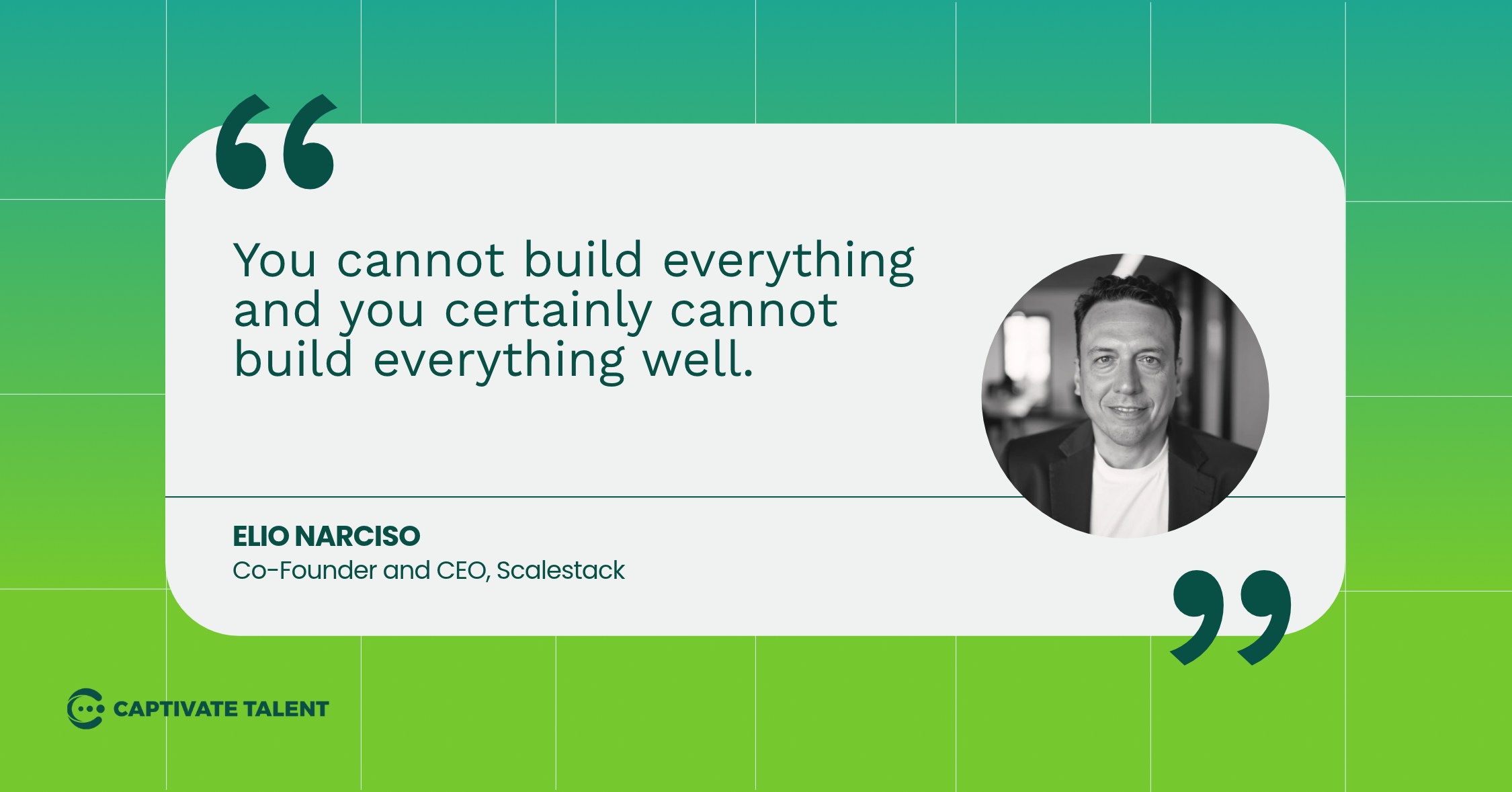
"You cannot build everything and you certainly cannot build everything well."
Every new tool introduces something else to maintain, monitor, and potentially troubleshoot. AI also comes with real operating costs, which can become significant as usage grows.
Sometimes an AI agent is the right solution. Sometimes a straightforward automation will do the job more reliably and cheaply. And some work still benefits from having a person handle it.
The decision should come from understanding the problem, the cost, and the outcome you're trying to achieve.
That judgment becomes increasingly important as the number of available tools grows.
The advantage comes from knowing where to focus
It's easy to understand why founders are excited about what AI makes possible.
Smaller teams can accomplish work that previously required far more people. Revenue organizations can research, analyze, and act on information at a scale that would have been difficult to imagine a few years ago.
Those capabilities are genuinely valuable.
But the fundamentals of building a good go-to-market organization haven't disappeared.
You still need to understand who your customers are, why they buy, and where your team should spend its time. You need people who can make good decisions with incomplete information and recognize when something doesn't look right.
AI gives those decisions more reach.
Which makes getting them right even more important.
For more of Elio's perspective, listen to his full conversation on Human First.