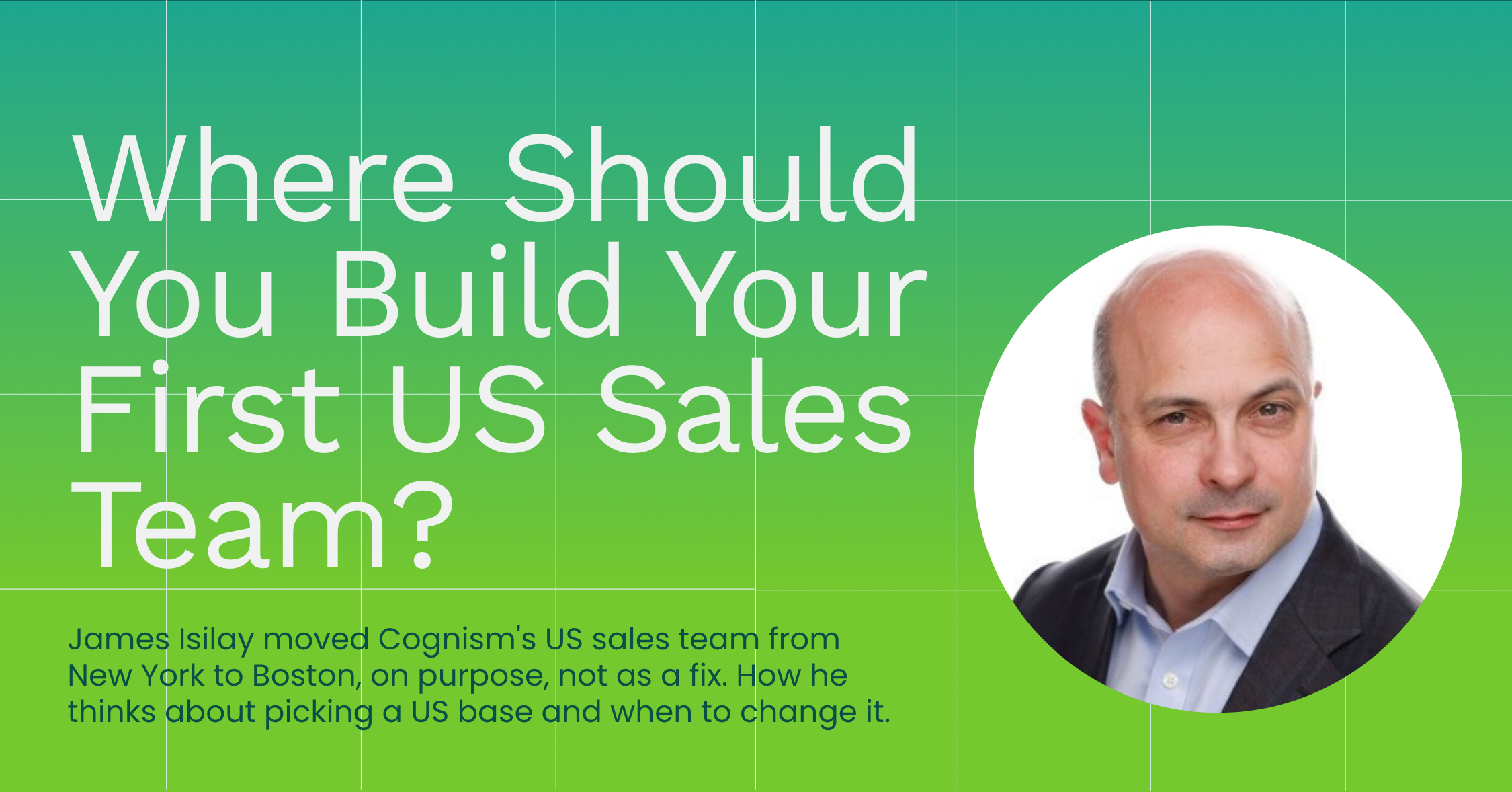
Where Should You Build Your First US Sales Team?
We sit across the table from a lot of founders early in their US planning, and there's almost always a city already picked: usually New York, sometimes San Francisco, often before a single hire is even on the calendar. That instinct makes sense. It's rarely the thing that actually decides whether US expansion works.
James Isilay ran straight into this question himself. Cognism, the UK-based B2B data company he built into an $80 million ARR business, started its US footprint in New York. Then, deliberately, it moved to Boston. The reasoning behind that move tells a founder more than the debate over which city sounds right.
There's No Universal Right City
Isilay's actual logic for choosing a city has less to do with reputation and more to do with where the specific talent for the business already lives. For Cognism, that turned out to be Boston, home to a deep bench of B2B sales intelligence talent with real experience selling into that exact market.
"There's hiring people that are generally good salespeople and then hiring people that are very good salespeople in your product area."
New York gave Cognism volume. Boston gave it depth.
He's heard plenty of confident opinions about which city is the right one. At one point people kept telling him Salt Lake City was the answer, on the strength of its sales culture. What actually matters is which city has the people doing the specific work a given business needs done, regardless of reputation.
The Costs That Don't Change by City
Some of the math behind a US base is the same no matter where it lands. Isilay puts the all-in comp premium somewhere around 20 to 30 percent above UK numbers, and marketing tends to run 1.5 to 2 times the UK cost once it's built out properly. That gap shows up in New York, Boston, or anywhere else.
What shifts from city to city is how deep the bench is for the specific skill set a business needs, and how much competition there is for the people in that bench. Those are the two variables worth running the numbers on before signing a lease.
What Actually Breaks at Scale
New York wasn't a mistake for Cognism. It's where the team's early hires wanted to be, and the city helped them get the US motion off the ground in the first place. The trouble showed up later, once the goal shifted from getting started to building out a large team.
Cost was part of it. So was competition: more companies chasing the same sales talent, and more turnover because of it. Isilay's read on the city itself was blunt:
"You get very tired very quickly in New York."
That's a predictable cost of building a sales team somewhere everyone in it has a dozen other offers a phone call away, not a flaw unique to New York.
What Happens When the City Outruns the Plan
A European competitor of Isilay's raised a Series A and put it straight into an expensive sales team in San Francisco, one of the most competitive, least forgiving sales markets anywhere. Leadership stayed in Europe. The team had no real connection to the product and no brand to lean on in a market with very little patience for either.
"That's the worst recipe and the best way to burn money very quickly," Isilay said. The company didn't survive eighteen months.
San Francisco mattered less than what happened around it: a team built somewhere expensive and competitive, asked to forge a connection to the product and the market on its own, while leadership stayed home.
Geography Is a Decision You're Allowed to Revisit
Cognism's move from New York to Boston worked as the plan all along: land somewhere accessible to get the US motion started, then relocate once it's clear exactly what kind of talent the business needs to scale.
That second move only works if someone is actually paying attention to the market in the meantime, not just checking in at the quarterly board update. Isilay and his leadership team rotated through their US base constantly in the early years, three weeks out of every month with someone from leadership on the ground. The Boston decision came from people who had genuinely spent time in the market they were trying to read, not from a guess made at a distance.
The first US city a company lands in doesn't have to be the last one. What matters is staying close enough to the market to notice when a location stops working, and being ready to move toward the talent when it does.
If you're working through where your US team should actually be, we'd love to help you think it through. Talk to Captivate Talent.