$4.5 million.
That's the floor. For a fairly standard $300K OTE sales hire ($150K base, $150K commission, a 10% commission rate), you need at least $4.5 to $6 million in qualified pipeline in year one to give that person a real shot at hitting quota. And that's before accounting for the fact that a new hire will only generate 30 to 50% of that pipeline themselves. The rest has to already be coming from somewhere else.
Most founders find this number out by accident, usually around month nine, after they've already made the hire.
Rav Dhaliwal has spent two decades on both sides of this decision. First as an operator building go-to-market teams at Slack, Zendesk, and Yammer. Now as a partner at Crane Ventures, watching founders make the call he used to have to make himself. The pattern he keeps seeing isn't really about who gets hired. It's that the math never gets run before anyone starts looking.
Where the $4.5 Million Comes From
Walk through it and the logic holds up. Whoever you hire is going to care about one thing more than your product roadmap, your mission statement, or your culture deck: hitting that commission number.
"Every good salesperson wants to earn a commission. They want to hit their quota and earn their commission."
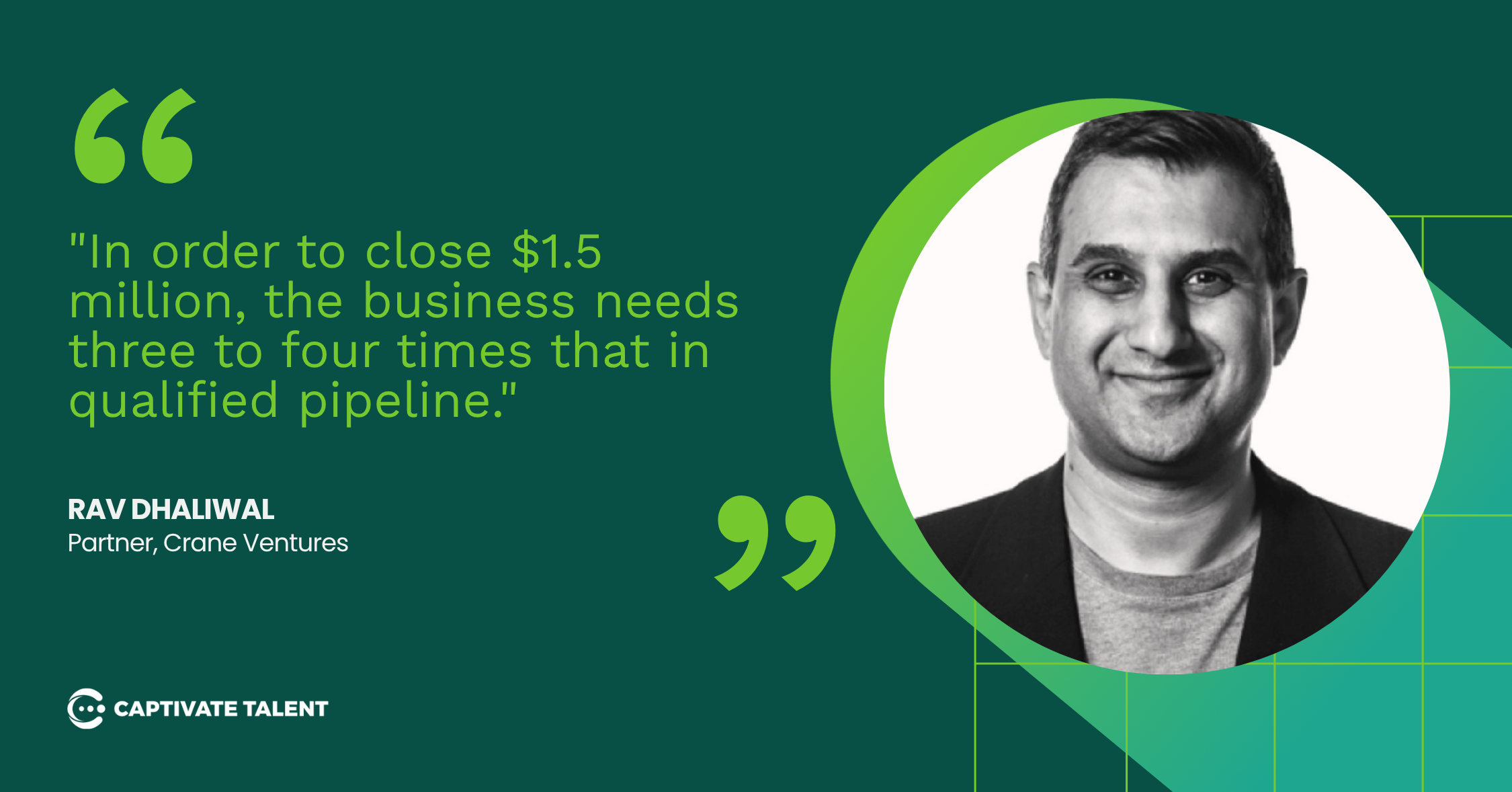
At a typical 10% commission rate, hitting that $150K commission target means closing $1.5 million in business in year one. And closing $1.5 million takes three to four times that in qualified pipeline, somewhere between $4.5 and $6 million. That's the number sitting underneath the job posting, whether anyone wrote it down or not.
Why That Number Is Bigger Than It Looks
Here's the part worth sitting with for a second. "At best, you could expect them to do somewhere between 30 to 50% of the pipeline," Rav says. The rest has to come from somewhere else already in motion: demand gen, outbound, referrals, something that's working before this person walks in the door.
So the real question isn't just whether you can afford the OTE. It's whether you already have an engine generating two or three million dollars of qualified pipeline a year, independent of whoever you hire. If that engine doesn't exist yet, the new hire isn't going to build it for you. They're going to need it to already be running.
Why a Bad GTM Hire Takes a Year to Show Up
This is what makes timing more dangerous on the GTM side than almost anywhere else in an early-stage company. A bad engineering hire shows up fast. Code gets committed, and the quality becomes visible within weeks. A bad GTM hire takes much longer to surface, sometimes the better part of a year, because the signals along the way (a quiet pipeline, a slow ramp, deals that stall) all look like things that could still turn around.
Rav has a name for what builds up in the meantime: management debt. You're busier than you should be, you're spending more time on corrective action than you expected, and you can't quite tell whether the role is working or whether you're just waiting it out. By the time it's clear, the cost isn't a bad quarter. It's the runway you spent finding out.
Three Things to Have Figured Out First
Before any of the math above, Rav uses a simpler filter with founders by asking these questions:
- Have you found at least one ideal customer profile you've sold to repeatedly, not once, but as a pattern?
- Do you have something close to a sales process, even a rough one, that you could actually hand off and teach someone else?
- Do you have a consistent way of generating qualified pipeline for that customer profile, something that doesn't depend on the new hire inventing it?
If the answer to any of those is no, the timing isn't right yet. Not because you're behind. Because the role doesn't have anything to plug into yet.
If a board member or investor is the one applying pressure here, Rav has a workaround worth borrowing: agree to it, then move very slowly. "You could just comply with that request, but just very slowly," he says. Go meet the candidates they're excited about. Take your time deciding if it's a fit. Keep doing the work that actually moves the needle while the search quietly runs in the background.
What to Hire Instead of an AE
None of this means gritting your teeth through another quarter of founder-led sales. If you're the one still running every demo, every follow-up, every deck, the exhaustion is real, and wanting someone to take it off your plate is the right instinct. The only question is what kind of help actually delivers that relief right now.
Rav's answer: hire a GTM associate before you hire an AE. Someone earlier in their career, hungry to break into the GTM side, who sits next to you and takes over what he calls the grunt work: the outreach, the pipeline building, the deck assembly, the scheduling. You keep doing the part only you can do right now, the actual selling and the actual learning from prospects, while someone else absorbs the volume.
This isn't a smaller version of the hire you actually wanted. It's the faster path to the relief you're actually after. An AE takes longer to find, costs more, and based on everything above, is more likely to struggle if the fundamentals underneath them aren't there yet. The associate can start helping within weeks. By the time you've built the three things Rav mentioned, you'll have a much clearer picture of who your first real GTM hire needs to be.
You're Allowed to Slow Down Here
This was never about confidence, even though it can feel that way. The founders who get their first GTM hire right aren't the ones who felt the most certain going in. They're the ones who found the right kind of help before trying to hire their way out of a problem a salesperson alone couldn't fix.