On paper, the candidate looks perfect.
They've exceeded quota consistently. They've worked at companies you admire. They've earned promotions, made President's Club, and have the numbers to back it all up.
You can picture them walking into your startup and doing the same thing for you.
But there's a question worth asking before you make the offer: How much of that success will translate to your company?
It's a particularly important question for early-stage founders. When you're hiring your first few salespeople or bringing on a sales leader to build the function, you're asking someone to succeed in an environment that probably looks very different from where they've worked before.
And a great track record can only tell you so much about how they'll perform in it.
The environment matters more than you think
When Peter Zotto was building ProfitWell, he and his co-founders needed to hire their first dedicated salespeople.
At the time, HubSpot was one of the biggest success stories in Boston tech. The company had a strong sales training program, a recognizable brand, and a reputation for producing talented salespeople.
For an early-stage company trying to build its own sales organization, hiring someone who had already succeeded there seemed like a pretty reasonable bet.
So ProfitWell hired a couple of them.
It didn't work out.
The salespeople they'd hired were accustomed to an environment with established processes, sales support, and a brand that customers already recognized.
ProfitWell had very little of that.
The company was still figuring out its positioning, building its sales motion, and convincing customers they needed a product they'd probably never heard of.
As Peter explained on Human First, the people they hired weren't bad salespeople. They were simply accustomed to a different kind of selling.
They'd been successful in an environment designed to support that success. ProfitWell needed people who could help create the environment in the first place.
Both are valuable skills. But they don't always come together.
A great track record only tells part of the story
Sales hiring tends to put a lot of weight on outcomes.
Quota attainment. Revenue generated. Average deal size. President's Club. Promotions.
And for good reason. These are useful indicators of someone's performance.
But the numbers don't explain the circumstances behind them.
Consider two account executives who both hit 140% of quota:
- One works at a company with a strong inbound engine, an established sales process, and a product customers are actively searching for.
- The other works at a relatively unknown startup, builds much of their own pipeline, helps refine the messaging, and figures out how to sell a product the market doesn't fully understand yet.
Both have achieved something impressive. Both might be excellent salespeople.
But if you're hiring someone to build an outbound motion from scratch, their experiences tell you very different things.
Peter put it well:
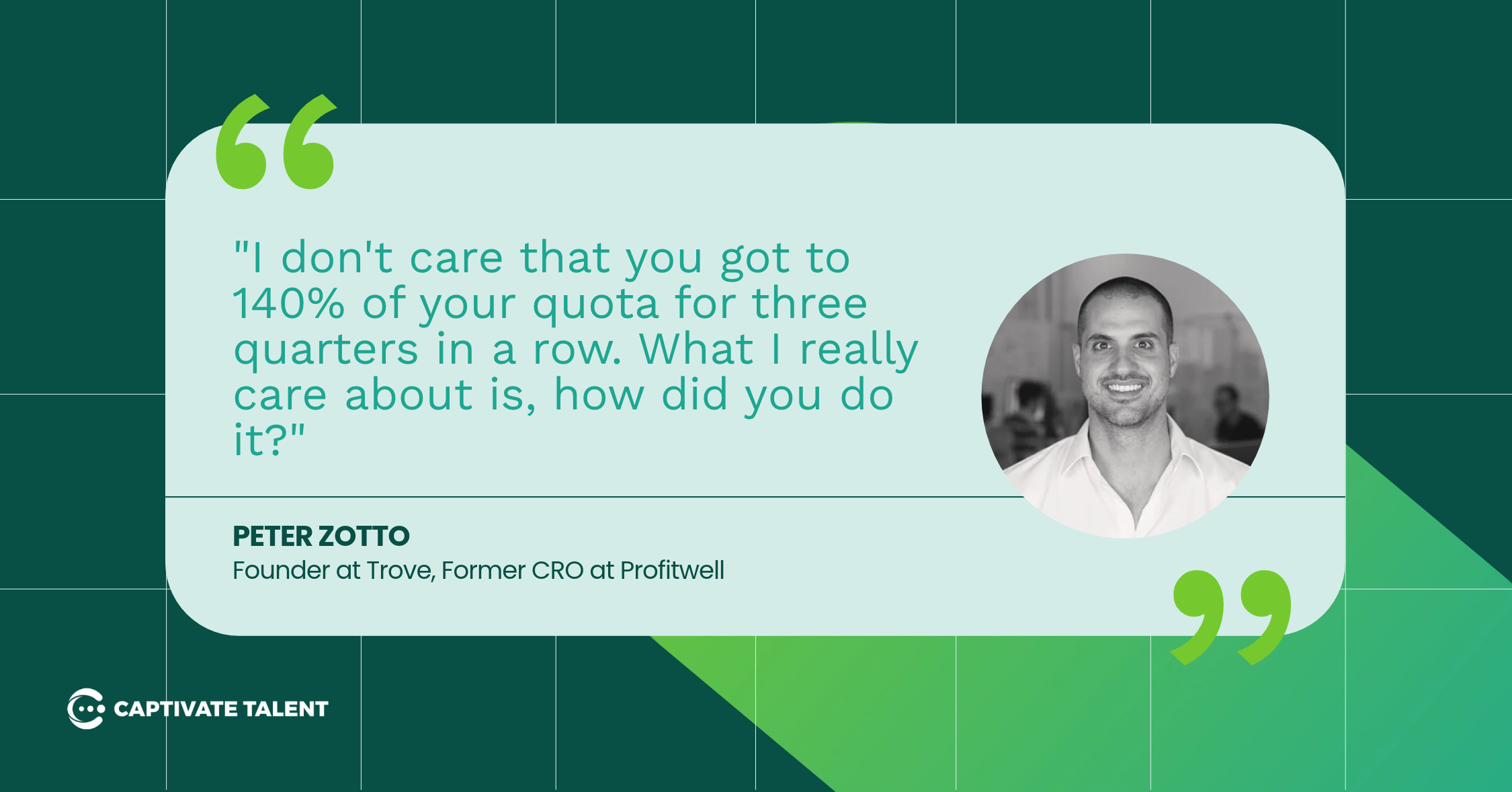
"I don't care that you got to 140% of your quota for three quarters in a row. What I really care about is, how did you do it?"
That question gets at something a resume rarely captures:
- What resources did the person have?
- What challenges did they face?
- What did they personally contribute?
- Who did they work with, and how did those relationships influence the outcome?
The answers help you understand the skills someone actually developed, rather than relying entirely on the results they achieved.
Ask how they got there
There's a practical way to get at this during an interview, and it doesn't require an elaborate assessment.
Start with something the candidate is proud of.
Maybe they grew a territory by 200%. Maybe they built a sales team from five people to twenty. Maybe they consistently outperformed their peers.
Then get curious about the details.
- What was happening at the company when you started?
- What did the sales process look like before you got involved?
- What specifically did you change?
- Where did your pipeline come from?
- Who helped you achieve that result?
- What would you do differently if you had to do it again?
Peter's approach is to keep asking why, going a few layers deeper than the initial answer.
For example, a candidate might tell you they exceeded quota because they developed a successful outbound strategy.
Great. What made that strategy successful?
Maybe they discovered a customer segment that competitors had overlooked.
How did they identify it? What did they test? How did they know it was working?
Eventually, you start to see how the person thinks, makes decisions, and responds when something isn't working.
You also learn whether they understand their own success.
Someone who can explain the decisions behind an outcome, including the contributions of other people, gives you a much clearer picture of what working with them might look like.
Hire for the slope
One of Peter's most interesting ideas is what he calls "hiring for the slope."
"I think a lot about hiring for the slope, not the data points."
The data points are everything a candidate has already accomplished. They're important, but they're historical.
The slope is where they might go next.
For an early-stage founder, this distinction matters because the job you're hiring someone to do will almost certainly evolve.
Your first sales leader might need to close deals personally, establish a repeatable sales process, recruit the next few hires, and eventually manage a larger organization.
Someone who's excellent at managing a mature sales team may have limited experience building one.
And someone who's never held a VP title might have exactly the experience you need for the next stage of growth.
Peter suggests asking candidates to connect their past experience directly to the problems your company needs to solve.
Tell them where the business is today, what you're trying to accomplish over the next year or two, and what resources they'll have available.
Then ask how they'd approach it.
You're looking for how they apply what they've learned, what assumptions they make, and what additional information they need.
A thoughtful candidate might challenge part of your plan. They might ask questions you hadn't considered. They might recognize that something that worked at their previous company wouldn't make sense at yours.
Those conversations can reveal more about their potential than another impressive bullet point on their resume.
Look for the people who saw the work happen
There's another challenge with evaluating someone's track record: most of the evidence lives inside companies they no longer work for.
The CRM holds the pipeline history. Their former manager remembers how they approached a difficult quarter. Their colleagues know whether they were collaborative, resourceful, or good at taking feedback.
Very little of that makes it onto a resume.
And as AI makes it easier to produce polished applications, the written version of someone's career becomes an increasingly limited source of information.
Peter's current company, Trove, is built around this problem: helping people document their work and gather evidence from the people who experienced it firsthand.
But the underlying principle applies regardless of what tools you use.
When you're evaluating a candidate, look for people who can speak to how they worked.
A former manager might confirm that someone exceeded quota. A colleague might tell you how they helped improve the sales process, collaborated with marketing, or handled a deal that nearly fell apart.
Those details give the achievement context.
They also help you understand what the candidate might bring to your company beyond the metrics on their resume.
The best hire depends on what you're building
There's a reason recognizable company names and impressive performance numbers carry so much weight in hiring. They're easy to compare, and they give us some reassurance that someone knows what they're doing.
But a person's success is shaped by the environment they worked in, the opportunities they had, and the people and systems around them.
Understanding those conditions makes it easier to see where their experience will translate and where they might need to adapt.
The salesperson who thrives at a company with a mature inbound engine may be exactly who you need once you've built one. The person who loves figuring things out with limited resources might be better suited to your first sales hire.
Both can be great hires.
The question is whether the work that made someone successful before resembles the work you're asking them to do next.
And that's a much more useful place to start a hiring conversation.